The door moves faster when the ID reads itself
Age verification for bars, nightclubs and venues — running on the phone already in your doorman's pocket. Scan the barcode, get a verdict, keep a record your licensing authority will accept.
Free, iOS 16 and later. No account, no purchases.
DRIVER LICENCE
CLASS C
VERIFIED IN 0.4s
DOCUMENT SUPPORT ROADMAP
HOW IT WORKS
Three seconds at the door, start to finish
Point at the barcode
The PDF417 strip on the back of a licence holds the data in machine-readable form. No typing, no squinting under a UV torch.
Read the verdict
Age, expiry and document integrity resolve into one word your door staff can read at arm's length in the dark.
Keep the record
Every scan is logged with a timestamp. When a licensing officer asks what happened on a given night, you have an answer.
The app
Swipe, or use the arrows below
Scan IDs In 1 Second
Pass or deny, decided at the door while the queue keeps moving.
Sub-1 second
Every scan
Accurate
& reliable
Pass or deny
Instantly
No extra
Hardware
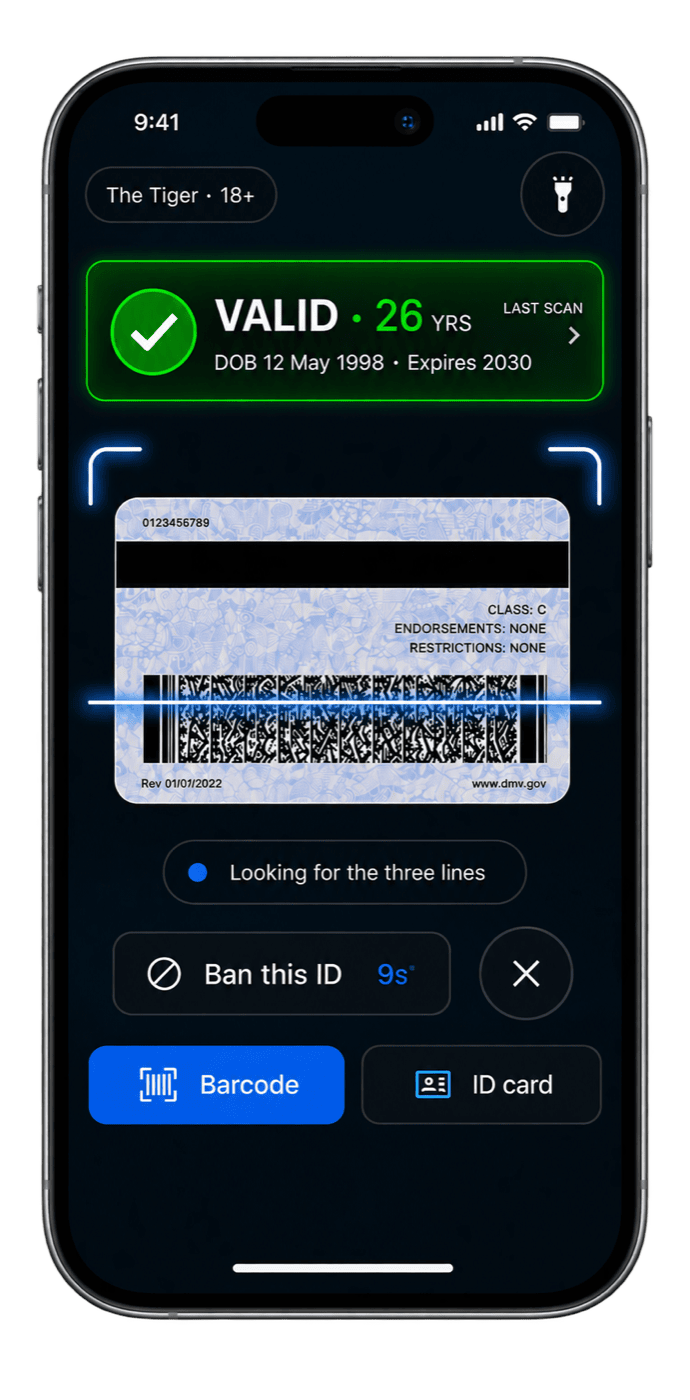
100% Offline & Privacy First
Scans work without Wi-Fi. Nothing leaves the phone unless you export it.
100% offline
Scanning
Privacy first
No data upload
Fast & reliable
In low light
All-day
Battery life
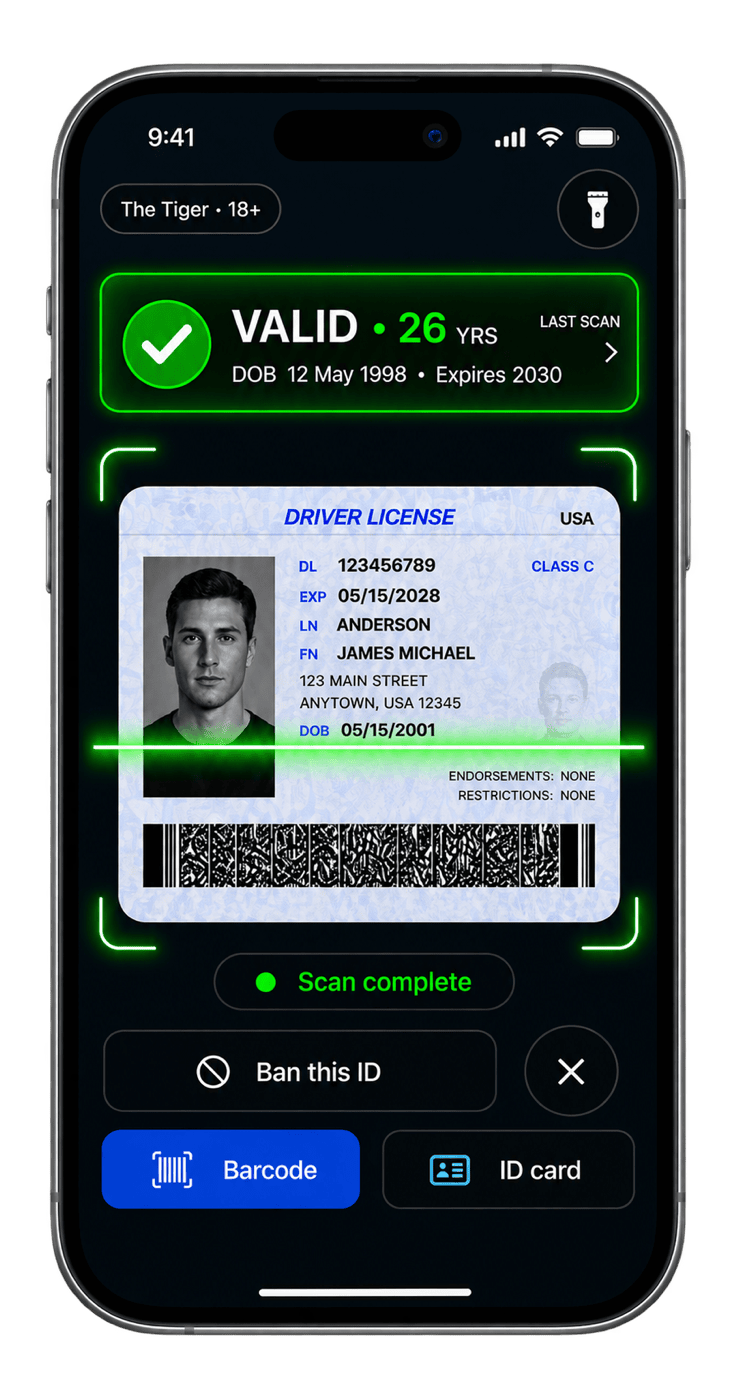
Spot Expired IDs
Advanced barcode fraud signals and automatic expiry checks.
Detect expired
IDs instantly
Fake ID signals
Barcode fraud checks
Expiry checks
Never miss a date
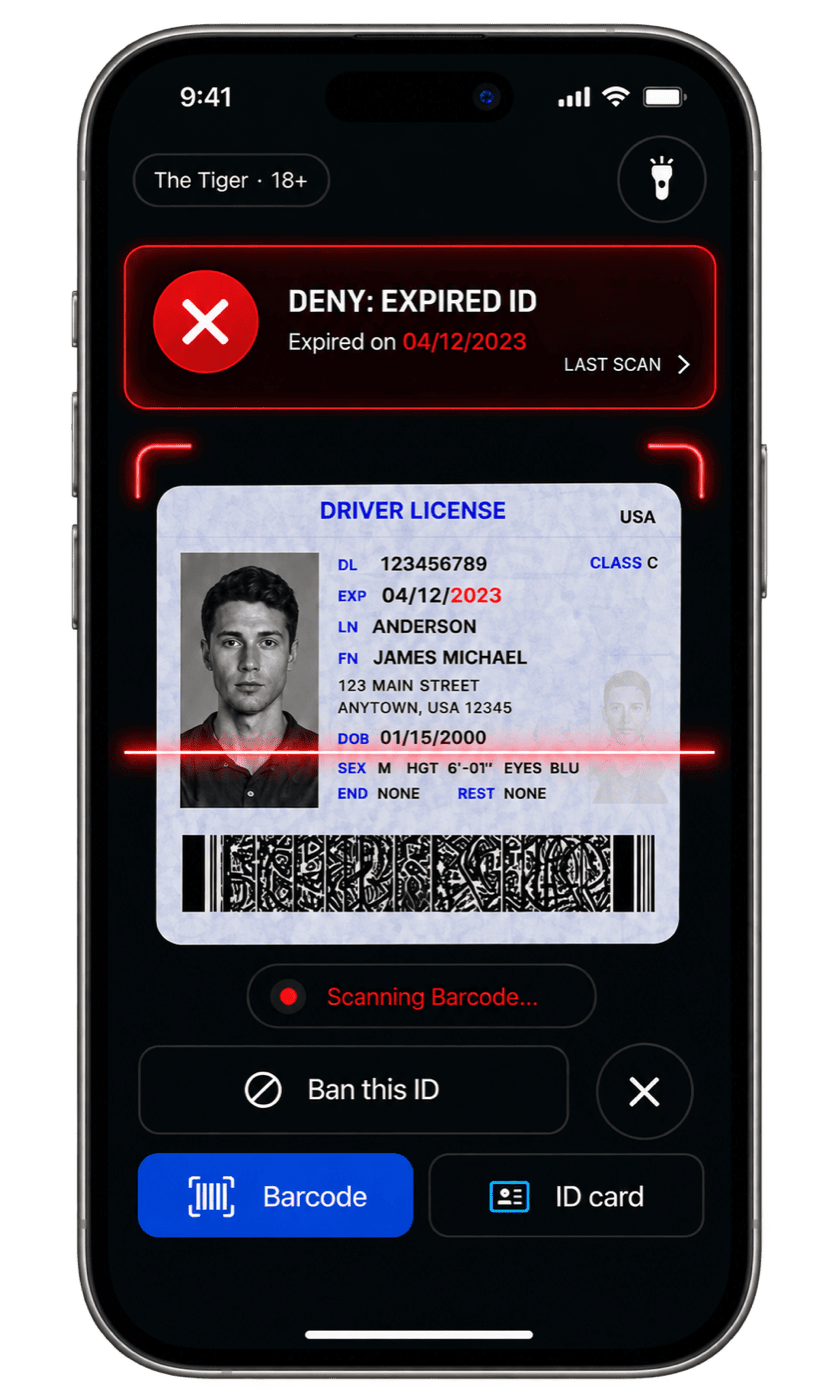
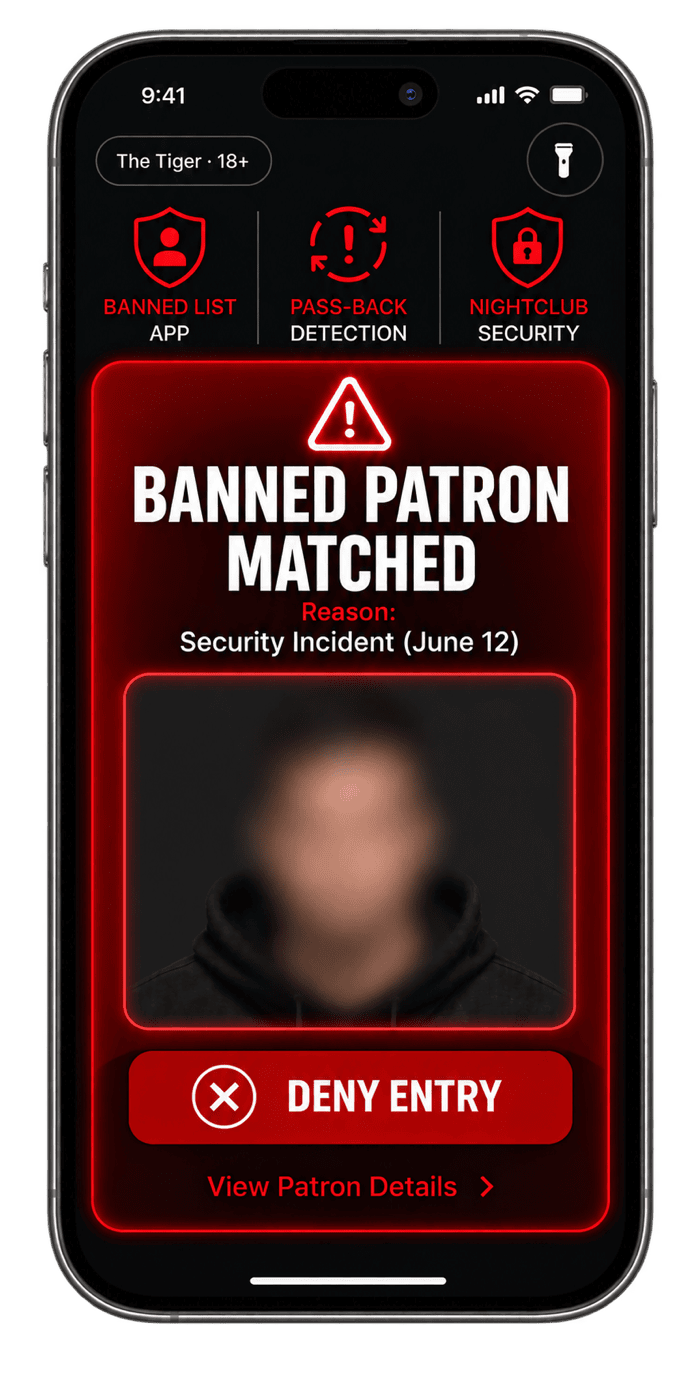
Instant Banned Patron Alerts
Flag the guests you have refused before, and catch an ID handed back down the queue.
Banned list
On the door
Pass-back
Detection
Nightclub
Security
WHAT IT DOES
Built for the door, not the boardroom
Every feature here exists because a venue operator described the problem it solves. If yours is missing, email me and it goes on the list.
Licences and passports
US and Canadian AAMVA barcodes, plus the machine-readable zone on passports and identity cards. One app instead of one scanner per market.
Sub-second verdict
A queue outside is a queue not spending money inside. The verdict has to land before the next person steps up.
Flag a document, not a memory
Flag an ID once and that phone recognises it on every later scan. Stored as an irreversible code, so the document number itself is never kept.
A log you can read back
Every scan timestamped with its outcome and the reason for it. The record you cannot reconstruct from memory on a Monday.
Audit-ready exports
Export the log as a dated CSV and hand it to a licensing authority. Diligence you can prove beats diligence you claim.
No signal, no servers
Basements, warehouses, festival fields. There is no network code at all — nothing to stall, and nothing leaves the phone.
FIELD NOTES
What we are learning at the door
Can You Lose Your Liquor Licence Over a Fake ID? Affirmative Defence, Explained
A minor gets past your door on a good counterfeit. Are you automatically liable? In many states, no — but only if you can produce evidence of what your team did. Here is how affirmative defence works and what it requires of you.
Read COMPLIANCEID Scanning Laws by State: What You Can Record, and How Long You Can Keep It
Scanning is legal nearly everywhere. What varies — a lot — is what you may retain and for how long. A guide to the three regulatory postures states take, the statutes to look up, and how to get a definitive answer for yours.
Read COMPLIANCEIs Scanning Driver's Licences Legal? A Venue Guide to CCPA, BIPA and Retention
Scanning an ID for age verification is legal almost everywhere. What you do with the data afterwards is where venues get into trouble — and where the class actions come from. A plain guide to the rules that actually apply to your door.
ReadQuestions worth asking
The basics
When does it launch?
It is out now on the App Store, listed as Bodyguard: ID Scanner Pro, and free. iOS only for the moment — there is no Android version.
What does it cost?
The first release is free. No purchases, no adverts, no trial that expires. A hardware scanner starts a few hundred dollars per door and this costs nothing, which is the whole argument. If paid features arrive later, the free version keeps working and you will hear about it before anything changes.
Liability and your licence
Are we liable if someone gets in on a fake ID?
Yes. Serving a minor typically means a fine, a suspension, or losing the licence outright. But most US states also have an affirmative defence: if you can show you electronically verified the document at the door, the venue is shielded from administrative penalty even when the forgery was good enough to fool a person. That defence rests on having the record — which is the part a paper log, or a doorman doing date arithmetic in his head, cannot give you. Confirm the specifics with your own licensing authority; this is not legal advice.
How does scanning actually protect the licence?
Two ways. It takes the date maths away from a person standing in a dark, loud room at 1am, which is where most honest mistakes happen. And it leaves a timestamped record of every check and its result — the audit trail you put in front of a liquor board or an inspector to show due diligence. Requirements differ by state and country, so confirm with yours.
Catching fakes
Is a phone camera fast enough, or do I need hardware?
Fast enough. The PDF417 barcode on the back of every US and Canadian licence decodes in a fraction of a second on any recent iPhone — the camera frameworks are built for exactly this. The dedicated scanner sold for this job is a single-purpose device you buy, charge, carry and eventually replace, doing something the phone already in your pocket does.
How can software catch a fake that looks real to me?
Because a card is two things to forge, and most fakes only bother with the one you look at. The front gets copied well; the barcode behind it gets the encoding wrong. So the checks are structural — does the barcode agree with the printed front, is the field syntax right for that issuing state, is the expiry logic coherent, has the document been altered. It catches the common ones. It will not catch a well-made forgery, and any product claiming otherwise is selling you something. It is a strong first filter, not a replacement for a trained door.
What is anti-passback?
A patron of age gets scanned, walks in, then passes their ID back down the queue to an underage friend. Flag the document and that phone recognises it on the next scan, so the door sees the reuse instead of waving it through. It is matched by an irreversible code rather than the stored document number — and it works on that device only, because there is no sync.
On the door
Does it work with no internet?
It never needs one. There is no network code in the app at all — age calculation, barcode parsing and your flagged documents all resolve on the device. Basements, warehouses, festival fields: a queue cannot stall on a connection the app never asks for.
We run several doors. Do flags carry between phones?
No, and it is worth being plain about it. Each phone keeps its own flags, matched with a key generated on that device — a flag raised at the main entrance is not visible at the VIP door. That is the direct cost of having no servers, and for a multi-door venue it is a real limitation rather than a detail. If it is what your venue needs, tell us: sync means building a back end, and it should be venues asking for it that decides whether that happens.
Privacy and the law
Is scanning IDs legal where I am — CCPA, BIPA, GDPR?
Age verification for alcohol, tobacco and venue entry is permitted in most jurisdictions. What varies is what you are allowed to keep afterwards, and for how long — venues get caught out on retention, not on the scan itself. The safe posture is to read the document, derive the answer, and not hold identifying detail you have no reason to hold. Rules differ by state and country; confirm yours. This is not legal advice.
Do you store customers' ID data?
No. The app has no network code, so nothing can leave the phone. By default a scan record holds the time, the outcome and the reason — no name, date of birth, document number or address. There is a setting to store those details if your licensing regime requires it, off unless you turn it on, and turning it back off erases them from past scans. Records delete themselves on a retention window you set. The privacy policy sets all of this out in plain language.
Will this satisfy my licensing authority?
It gives you a contemporaneous, timestamped record of checks performed, which is what most authorities want to see. Requirements differ by state and country, so confirm with yours. This is not legal advice.
Put it on the door tonight
Free, with no account to create and nothing to buy. Install it, set your minimum age, and scan the first ID before the queue builds.
iOS 16 and later · Something missing for your door? Tell us.